
Emmet County Tax Record Fields
Emmet County tax records span several systems. The county-linked BS&A record card carries the assessment and sale fields. The local treasurer handles the current bill first. After the local collection window closes, the Emmet County Treasurer takes over unpaid real-property taxes, so matching the parcel number and tax year keeps both records aligned.
| Field | What It Shows | Where |
|---|---|---|
| Assessed value | One-half of true cash value under Michigan assessment rules | Assessment record |
| SEV | State equalized value after equalization review | Assessment record |
| Taxable value | The capped value used in the tax calculation | Record card and bill |
| PRE or classification | Tax status applied to the parcel | Assessment record |
| Paid or delinquent status | Whether a year's charge remains due | Local or county treasurer |
An assessment figure reflects the assessor's valuation of a parcel, not what the open market would pay for it. Nor does any tax bill prove title. It simply shows the account billed for a stated year. When legal ownership is the question, rely on the latest recorded deed; when the issue is valuation or classification, use the assessment record.
Search Emmet County Tax Fields
Three keys work in the official property service. An address works when the street number is known. A parcel number is the strongest link. It holds across tax years and portals. A name search can find an owner, trust, or entity, though spelling variants may hide results, and the services listed in BS&A include detailed records, current tax, delinquent tax, property sale, and assessing searches.
| Search Key | Format | Best Use |
|---|---|---|
| Address | Street number and street name | Starting from a known site |
| Name | Owner, trust, or entity name | Finding accounts tied to one name |
| Parcel Number | Full county parcel identifier | Matching assessment and tax records |
The search runs on a vendor system. Save the unit, date, and tax year. Emmet County and BS&A both treat the data as reference information, so a saved result should name which service produced it rather than just "the county."
The visual layout helps. The BS&A assessing interface provides a useful check of the search and value workspace.
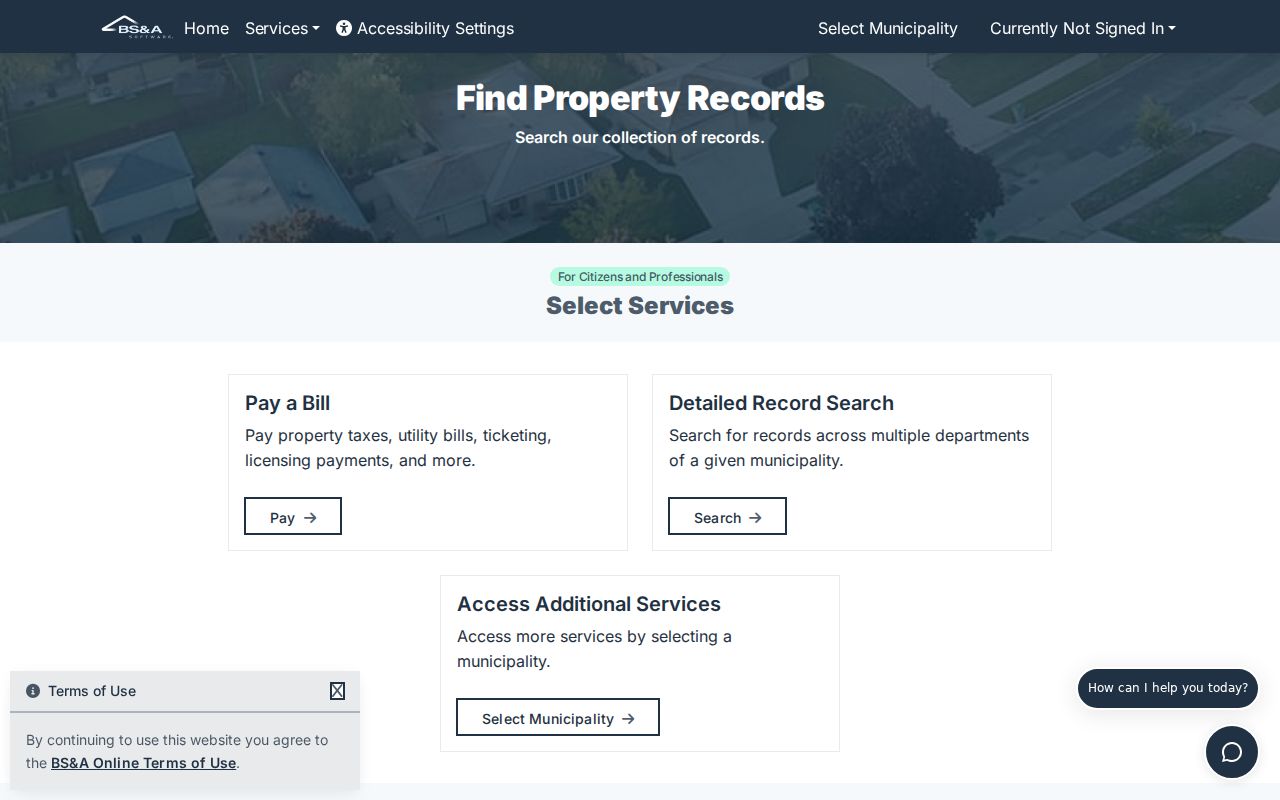
The vendor page identifies the official context. The live record still controls.
Note: Portal tabs can change, so record the access date and verify live labels before relying on any saved screen.
Look Up an Emmet Tax Bill
Start with the parcel, then follow the account. Current taxes stay with the local treasurer. That is the city, village, or township treasurer. Delinquent real-property taxes move to the Emmet County Treasurer on March 1. That handoff explains why a current local search and a county delinquent search can return different results for the same parcel.
- Search the property record by address and copy the complete parcel number.
- Confirm the local assessing unit and select the correct tax year.
- Read the charge, payment entries, and listed balance in the appropriate treasurer record.
- If the year is delinquent, verify status and payoff details directly with the county Treasurer.
Keep duplicate bills and payoff quotes separate. A portal balance shifts as interest, fees, and payments post. The Treasurer accepts partial payments on delinquent taxes. An unpaid balance still faces the statutory process, so ask for a dated payoff figure whenever payment or a closing depends on the number.
- Assessed value
- The assessor's estimate, generally half of true cash value.
- SEV
- State equalized value after county and state review.
- Taxable value
- The capped base used to calculate tax.
- Mill
- One dollar of tax per one thousand dollars of taxable value.
- Tax lien
- A legal claim arising from unpaid property tax.
Read Emmet County Tax Values
Michigan uses several value labels on one parcel. Assessed value is generally half of true cash value. Equalization then produces the SEV, a figure the county adjusts across jurisdictions. Taxable value is capped by the constitution. The cap holds until a transfer, addition, loss, or another statutory event changes the calculation. Each number answers a different question.
A sale does not reset the next SEV by formula. Emmet County's Equalization material says the assessor weighs the whole market. A transfer usually uncaps taxable value in the following calendar year, subject to statutory exceptions. Compare the deed date, the next assessment year, and the value history. That context explains a jump.
Transfer clue. A recorded deed, transfer-tax value, Property Transfer Affidavit, and assessor entry are related records, but they are not interchangeable.
Emmet County Tax Day
Michigan's assessment snapshot is called Tax Day. It falls on December 31 of the prior year. The parcel's status on that date shapes the next year's assessment roll, including ownership, classification, and exemptions. A later sale can therefore appear in deed records while the tax record still shows the earlier snapshot.
Compare dates before assuming an error. Note the Tax Day year, the recording date, the transfer date, and the portal's update field. For splits and combinations, keep both parcel numbers. That timeline often resolves what looks like a conflicting Emmet County property tax record.
Emmet Tax Exemptions and Forms
Tax status can change the bill without touching title. The Principal Residence Exemption, or PRE, concerns qualifying occupancy. Emmet County publishes Form 2368 to claim the exemption and Form 2602 to rescind it. Qualified agricultural classification and disabled-veteran relief follow separate forms and standards.
- Form 2368 claims a Principal Residence Exemption.
- Form 2602 rescinds a Principal Residence Exemption.
- Form 2599 concerns qualified agricultural property.
- Forms 3676, 5107, and 6054 concern listed exemption or appeal routes.
A PRE filing is not proof of ownership. It does not even prove current occupancy. Michigan may audit the current year plus the prior three. Record whether a document is a taxpayer affidavit, an assessor action, a Board of Review decision, or a state ruling. Each carries different weight.
Note: Use the current Treasury form and notice. Eligibility, proof, and appeal routes can shift by tax year.
Emmet Delinquent Tax Stages
Delinquency, forfeiture, foreclosure, and auction are distinct stages. Unpaid taxes transfer to the county in March. Forfeiture raises costs and opens a further redemption period. A court judgment and the later expiration of redemption rights are separate events, with the auction coming later still.
| Stage | Record to Check | Why It Matters |
|---|---|---|
| Delinquent | County tax account | Shows unpaid balance and payoff status |
| Forfeited | Treasurer notice | Signals added costs and redemption process |
| Foreclosed | Court judgment and Treasurer file | Establishes the legal stage |
| Auction | Official auction and later deed | Documents sale and eventual transfer |
A status label alone never proves a parcel transferred. Confirm the case file, the redemption status, and any instrument that was actually recorded before drawing conclusions. Emmet County's delinquent timeline moves through an April rights-expiration point and an August auction stage, though the live notice governs each year's exact dates.
Contest an Emmet County Assessment
Every appeal begins at the assessor for the parcel's local unit. Look over the notice itself. Check the property class, the measurements, the sales information, and anything factually wrong. From there, many valuation disputes go first to the local Board of Review. The county's Equalization office posts current explanations, forms, reports, and Board dates.
Valuation, classification, and special-assessment disputes that go unresolved reach the Michigan Tax Tribunal. Timing matters here. Some PRE and qualified-agricultural denials carry a 35-day filing route. Emmet's general valuation material flags June 30 for a current-year Tribunal appeal. These deadlines are not universal. The exact assessment notice and the current Tribunal rule always control.
Appeal window. Check the current local Board schedule and the deadline printed on the notice before filing; the correct route depends on the dispute.
Strong evidence does specific work. It identifies the parcel, the tax year, the disputed field, the correction you want, and the source behind it. A recent sale by itself will not reset an assessment. Comparable property data, photographs, measurements, deed facts, and a plain account of the errors help the reviewing body see the claim clearly.
Keep your proof of filing and the final decision. If the Board changes a value or classification, compare the later tax roll and tax bill against that order. Nothing changed? Ask which office updates the record, and when. A decision, a revised assessment, and an adjusted tax account are separate documents, and each one may post on a different date.