
Emmet County Deed Records and Their Uses
The Register of Deeds keeps every instrument filed against land in the county. An Emmet County deed record shows who transferred, who received, when the county stamped it, and which parcel it touched. Read those pieces together, along with any prior Liber/Page references. Labels can mislead. A deed's title alone never reveals every reservation, exception, or promise buried in its text.
| Deed Type | What It Does | Common Use |
|---|---|---|
| Warranty deed | Conveys the stated real-property interest with covenants expressed in the instrument. | Ordinary purchase transfers |
| Quitclaim deed | Conveys whatever interest the grantor has without the same covenants. | Family transfers or title cleanup |
| Survivor deed | Documents a transfer associated with survivorship and proof of death. | Death-related ownership change |
| Personal-representative or trustee deed | Transfers an interest through an estate or trust representative. | Estate or trust administration |
| Tax-related conveyance | Records a conveyance arising after the statutory tax process. | Post-foreclosure transfer research |
Not everything in the land-record system transfers ownership. Mortgages, assignments, liens, discharges, easements, covenants, and rights-of-way sit in the same indexes. They do very different work, though. A lien can burden an interest without moving the parcel at all. Whatever encumbers the land, a later discharge or release must be matched back to the original recording reference.
Open the County Recorder Portal
The Emmet County Register of Deeds portal opens its search tools to anyone who registers. Registration is free. Indexed results load a low-resolution preview. An “Add to Cart” button then starts the purchase workflow for a clearer copy. Two things stay separate here. The account only unlocks the index. Reading a full instrument may still require buying the document. The portal's landing screen displays the public registration and login path.
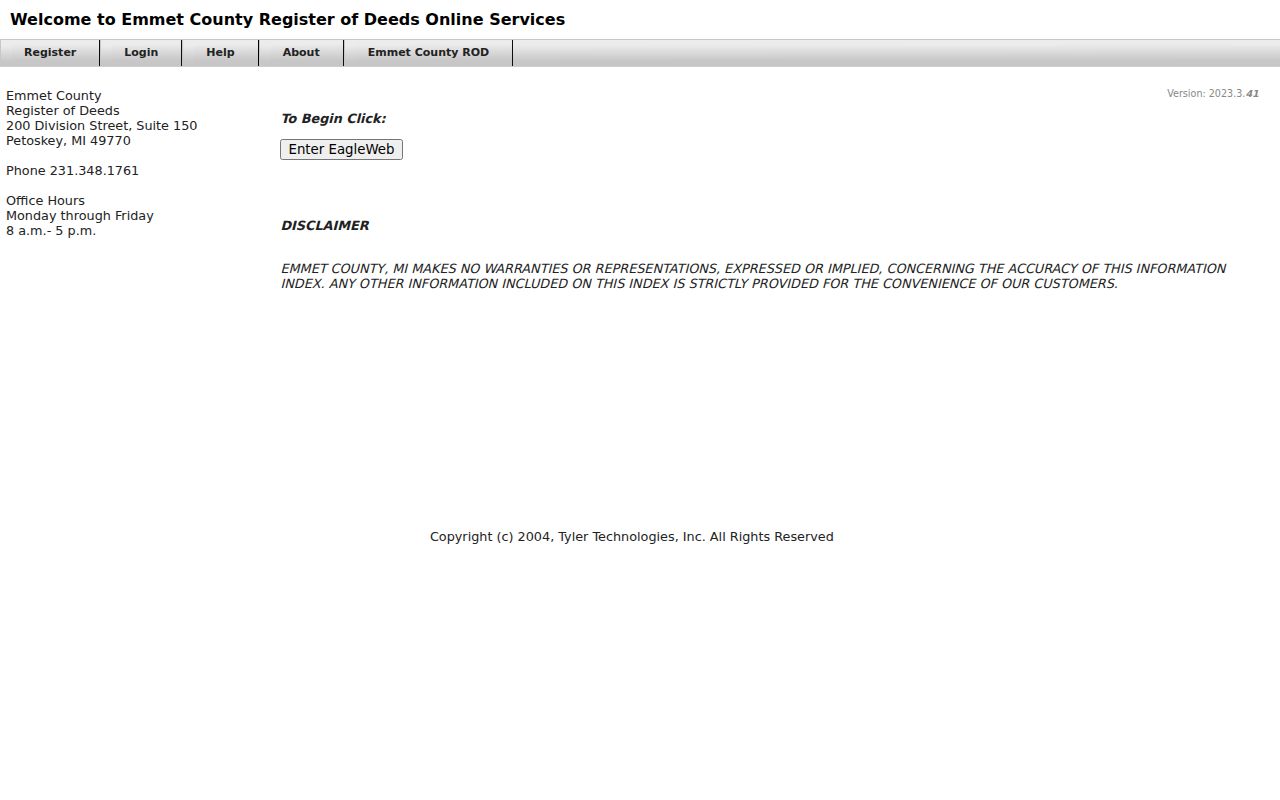
Bookmark that county-linked entry point rather than a third-party copy, and note your search date, since interfaces and fee notices change over time.
Search the Index with County Syntax
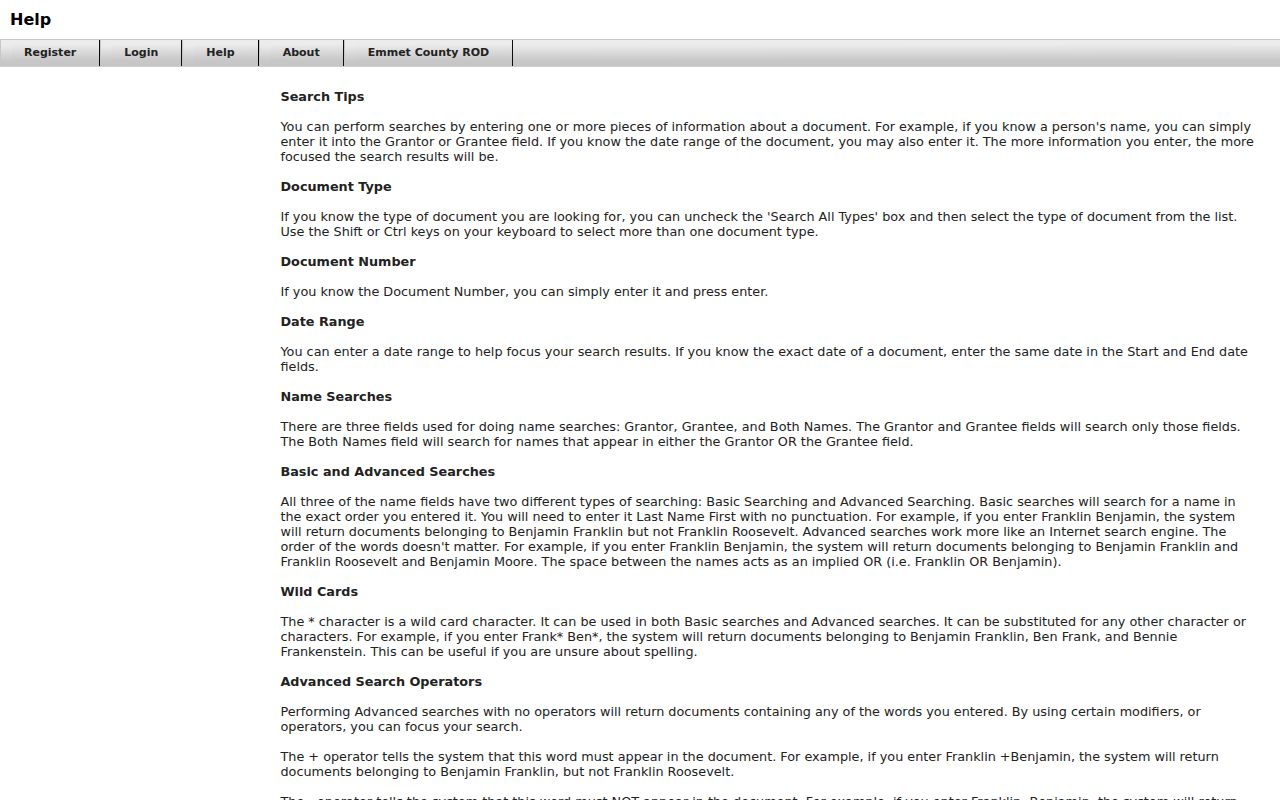
The official recorder help page spells out the search fields and the name rules. Basic name search takes Last Name First Name with no comma. The advanced version is looser. It accepts words in any order. It lets * stand in as a wildcard. It forces a word with + and excludes one with -.
| Index control | What to enter | Best use |
|---|---|---|
| Grantor | Seller or transferring party | Find what a person or entity conveyed |
| Grantee | Buyer or receiving party | Find an acquisition deed |
| Both Names | One searched name | Search either side of the index |
| Document type/number | Known instrument label or identifier | Narrow to a deed, lien, release, or exact filing |
| Date range | Recording interval | Separate same-name parties and transfer eras |
| Liber/Page | Book and page reference | Retrieve a cited or prior instrument |
The captured help screen preserves the portal's name syntax, operators, and result controls.
Search with controlled variants: initials, maiden and married names, trusts, estates, and exact business names. Then verify the hit using the legal description or the recording reference as a second key.
Separate Image Coverage from Index Coverage
Coverage has two layers in Emmet County. Images of land records reach back to 1852. But the general online index starts around 1922, and indexing of older material continues. That gap matters. An image can sit in the system while a modern name search misses it completely. Treat any empty online result for an early transfer as unproven. Check the stated coverage limit first.
| 1852 forward | The office reports deed-record image coverage reaching the county's early recorded-land era. |
|---|---|
| Generally 1922 forward | The period normally reached through the searchable online name index. |
| Before 1922 | Search index books, use office assistance, and provide legal-description or Liber/Page clues. |
| Preservation | Duplicate microfilmed copies are kept in underground storage. |
Emmet County has no known courthouse fire or total record loss. Never invent one to explain a gap. Instead, name the series you searched and ask the office or archive what that series actually covers.
Follow the Emmet County Grantor-Grantee Index
Start with a current parcel card only to get a candidate owner and a legal-description clue. The real chain of title runs backward through recorded instruments, one transfer at a time.
- Search the current owner as grantee and identify the latest plausible acquisition deed.
- Inspect the image or copy for grantor, grantee, recording date, legal description, and prior references.
- Search that grantor as a grantee in an earlier interval, then match the land description again.
- Repeat one instrument at a time; move to index books or an office request before the searchable cutoff.
- Grantor
- The party shown as transferring the interest.
- Grantee
- The party shown as receiving the interest.
- Chain of title
- The chronological sequence of instruments affecting a described parcel.
- Book/Page and instrument number
- Recording references used to retrieve and connect documents; preserve whichever the index supplies.
Inspect the Stamp and Description
An index entry is only a pointer. Pull the document and read the recording stamp. Read the execution and recording dates, the typed party names, and the acknowledgment. Read the stated consideration or transfer-tax reference too. Check the legal description and every attachment. A plat description should carry the plat caption and lot number. Court orders belong in certified, sealed form. A survivor deed needs a certified death certificate or similar proof under MCL 565.48. Preserve the restrictive language. Phrases like “part of,” “except,” “subject to,” and “together with” can point to easements, reserved land, simultaneous conveyances, or an earlier Liber/Page. A street address cannot substitute for that wording. Note: Execution, acknowledgment, recording, and assessment-update dates can differ. Label each date by the event it represents.
Use the Offline Land-Record Request
When the online index lets you down, go to the source. The Register of Deeds sits at 200 Division Street, Suite 150, Petoskey, MI 49770, and answers the phone at 231-348-1761. Office hours run Monday through Friday, 8:00 a.m. to 5:00 p.m. Visitors may search the index books themselves, and the county's land-record search request form offers another route. It asks for your contact details, the name to search, the township, village, or city, the section-town-range-quarter, any plat or condominium name, the parcel number, and the date range, plus whether you want complete documents or just Liber/Page references. Expect results to be informational and to take several days depending on workload. Older questions reach past the county counter. The Archives of Michigan guide lists deed and mortgage indexes, an 1885-1899 lien index, tax assessment rolls from 1864-1940, and delinquent tax returns from 1862-1958. Tie anything found there back to the recorded land description before trusting the sequence.
Compare Copy and Search Charges
Copies carry a price either way. Posted online copies run $1.05 per page. The office charges $1 per page, and certification lists at $5 per document. Recording a new document costs $30, with extra charges for certain multi-instrument assignments or discharges. Don't confuse the two. Filing fees pay to record; retrieval prices pay to read what already exists.
Confirm the search fee. The county page states $5 per 30 minutes for a land-record search, while the request PDF states $5 for up to 15 minutes. Ask the office which current measure applies before ordering.
Payment methods differ by channel. Online copy purchases take credit, debit, or escrow, while in-person recording is described as cash or check. Confirm the accepted method and total for the specific service before you go.
Watch for Fraud Alerts and Copy Solicitations
Emmet County's Register of Deeds offers a free alert service. Subscribe and you get notified whenever an instrument is recorded in your name. Treat each notice as a prompt. It is not proof of fraud, and it does not block anything from filing. It simply tells you to pull the recording and read it.
The office also flags a common mail scam. Private companies charge $50 or more for a copy of your deed. The county charges as little as $1 per page. Before paying an unfamiliar sender, confirm the recording and the real fee through the official Register of Deeds page.
Connect Trust, Estate, and Court Transfers
A tidy buyer-seller chain in Emmet County deed records can break in surprising ways. Trusts, survivor filings, personal representatives, probate orders, foreclosure judgments, and tax conveyances all interrupt the sequence. Chase each lead by name. Search the exact trust or estate name, the representative, spelling variants of the decedent, and any known heirs. Then hold the recording against whatever probate or circuit record exists.
The MiCOURT case search can surface a public case by number, title, or date range. It is not the official court record, though. Protected categories, including wills, stay out of it. A court event can supply a link in the deed chain. Then request the actual docket or a certified order from the Emmet County Clerk.
Build a chronology for any estate transfer. Lay out the death date if lawfully available. Include the probate opening, the representative's appointment, any court order or distribution, the deed execution, the recording, and the assessment-card update. Each date answers a different question. A trust may have taken the parcel years before death. It might never show up as a probate asset. Joint ownership or a survivor filing can move the interest through an entirely different route. Keep one more caution in mind. A missing probate result does not prove no death-related transfer ever occurred.
Get a Copy of an Emmet County Deed
Start with the portal preview to confirm an indexed item looks plausible. From there you have options. Purchase the online image. Get a plain or certified copy at the counter. Or submit the land-record request with enough detail for staff to identify it. A quick phone call confirms current fees. For an older record, pack the request with every known detail. Include former owners, the local unit, the legal description, the plat, section-town-range detail, and the Liber/Page.
Recorded, not guaranteed. Emmet County deed records show instruments accepted into the public system. The Register does not determine their legal sufficiency or intent, and the index is not a title opinion; use qualified title or legal help for priority, marketability, and unrecorded-interest questions.